"Ha'ir asher badad yoshevet Uvlibah chomah" "The city that sits solitary And in its heart, a wall"
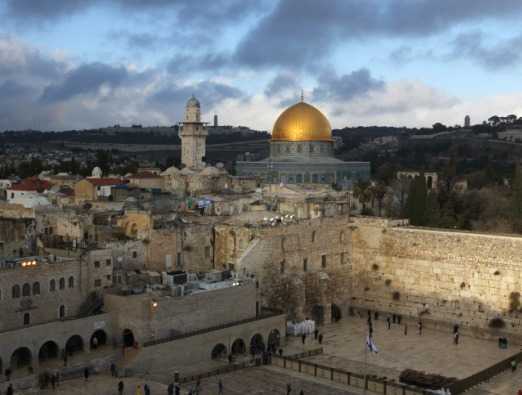
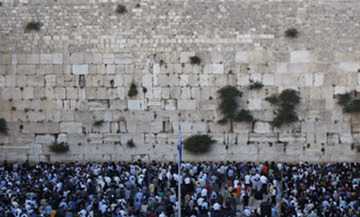
So Israel's beloved songstress Naomi Shemer cast the Holy City in her stirring paean to its time-worn elegance, "Yerushalayim shel Zahav" (Jerusalem of Gold). And truly, the Western Wall is the city's epicenter, a tawny monolith symbolizing a distant era of empires and holy men and embodying the tribulation, the faith and the memory of an ancient and wandering people. Hakotel Hama'aravi (The Western Wall) is the western retaining wall of the Temple Mount, built by King Herod as part of his ambitious program to greatly expand and beautify the Second Temple complex in the first century BCE.
When the Temple was destroyed by Roman legions in 70 CE, only the Western Wall remained standing. To the Jews of the time, the resilient wall was proof that God had not abandoned Israel, an attitude which became enshrined in the nascent written corpus of Jewish religious thought. For 2,000 years, Jews from all corners of the Diaspora made pilgrimages to their spiritual capital to touch the worn stones of the wall and be close to the site of the Holy of Holies where the Temple once stood. Seized along with the rest of the Old City in 1948 by the Jordanian army, the wall was retaken by Israeli forces as part of the campaign for the unification of Jerusalem in 1967. The capture of the Kotel and the return of Jewish sovereignty over the religion's holiest sites elicited a wave of euphoria in the country.
The Arab neighborhood abutting the wall was razed and the current broad plaza was built in its place, turning the entire complex into a large open-air synagogue under the authority of the Jerusalem Rabbinate. As a holy site under religious jurisdiction, certain rules must be followed when visiting the Western Wall: women and men must pray in separate sections; women must wear modest attire; men must cover their heads when approaching the wall; and any use of electronics is strictly prohibited on Shabbat.
24 Hours, 365 days a year

2000+ tips and recommendations
No results to show


|
Text text text
|
||